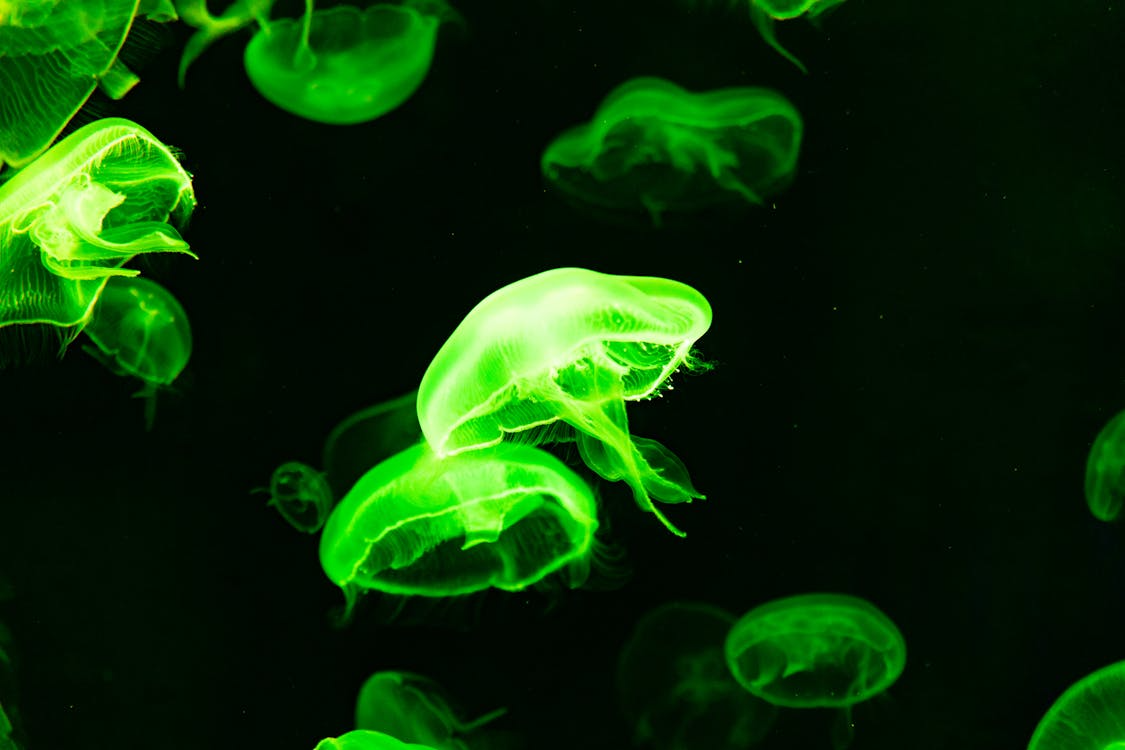
On a dark ocean night, the water can suddenly shimmer with soft blue light, as if tiny stars are drifting beneath the waves. This isn’t magic; it’s jellyfish bioluminescence, nature’s built-in light show.
Among the most captivating performers are jellyfish, which can glow brilliantly without a single spark of electricity. But how do they do it? What can their natural glow teach us about the future of technology?
The Chemistry of Living Light
Bioluminescence occurs when certain organisms, such as jellyfish, fireflies, and deep-sea fish, produce light through a chemical reaction inside their cells. The process centers around three main components:
- Luciferin – the light-emitting molecule.
- Luciferase – the enzyme that triggers the chemical reaction.
- Oxygen – the essential element that helps the reaction produce visible light.
When luciferin interacts with oxygen in the presence of luciferase, energy is released as photons or tiny packets of light. This reaction is incredibly efficient: nearly all the energy is emitted as light rather than heat. That’s why it’s called “cold light.”
In jellyfish like Aequorea victoria, another protein called green fluorescent protein (GFP) modifies this light, changing it from blue to green. This glow can help jellyfish startle predators, attract prey, or communicate in the dark depths where sunlight never reaches.
See How Do Bees Know Which Flowers to Visit? for another cue-driven natural system.
Nature’s Light Without Wires
Unlike human-made lights, jellyfish don’t need wires, batteries, or electricity. Their bioluminescence is self-contained and self-powered, generated by internal chemistry. The process doesn’t depend on an external energy source. All that’s needed are the natural molecular reactions that occur within their cells.
In some species, special light-emitting organs called photophores control when and where the glow appears. Deep-sea jellyfish can even trigger bioluminescent “explosions” by ejecting glowing mucus into the water, confusing predators or attracting mates.
This form of light is more than beauty; it’s survival. In the inky darkness of the ocean, light is communication, camouflage, and defense all in one.
Explore What Happens When Lightning Strikes Sand? for another stunning natural light effect.
From Ocean Glow to Scientific Breakthrough
The same green fluorescent protein that makes jellyfish shine has revolutionized modern biology. In the 1990s, scientists discovered that GFP could be inserted into other organisms to track cellular activity. When attached to specific genes, the protein glows under ultraviolet light, allowing researchers to watch how cells divide, move, or respond to drugs in real time.
Today, GFP and its variations are standard tools in genetic research, used in everything from cancer studies to neuroscience. In fact, the discovery was so transformative that it earned the 2008 Nobel Prize in Chemistry.
Through jellyfish, scientists gained a literal window into the living world and a way to visualize life at the molecular level.
Bioluminescence in Modern Technology
Beyond biology, jellyfish-inspired bioluminescence is influencing innovation in materials, medicine, and sustainable design.
- Medical Imaging: Researchers are developing new bioluminescent markers to detect disease earlier and with greater precision, using light-emitting proteins instead of radioactive tracers.
- Environmental Monitoring: Scientists are engineering bacteria that glow in the presence of toxins, allowing real-time detection of pollution in water or soil.
- Sustainable Lighting: Designers and engineers are exploring bio-based lighting systems that mimic jellyfish bioluminescence. They’re looking for ways to create lamps or signage powered by living microorganisms rather than electricity.
- Marine Robotics: Autonomous underwater vehicles are experimenting with glow-based communication inspired by bioluminescent species, allowing machines to “signal” each other in the deep ocean where radio waves can’t travel.
Each innovation borrows from the same principle: harnessing chemical reactions to produce light without heat or power grids.
See How Old Is the Oldest Living Tree on Earth? for a look at longevity in nature.
A Model for the Future
The elegance of jellyfish light lies in its efficiency and sustainability. In a world seeking cleaner energy, bioluminescence offers a glimpse into how nature produces illumination without waste. The challenge for engineers and biologists is scaling these microscopic reactions into usable systems—whether for medicine, energy, or environmental restoration.
Some scientists even envision glowing trees or algae-lined walkways that could light cities naturally. While that’s still experimental, the concept underscores how ancient organisms like jellyfish continue to inspire modern innovation.
Read Could Trees Really Communicate Through Underground Networks? for nature-inspired networks.
The Ocean’s Living Lanterns
Jellyfish have been glowing in the deep for over 500 million years, long before humans learned to control fire or electricity. Their light is a reminder that nature solved many engineering problems long before we arrived—quietly, efficiently, and beautifully.
Every flicker beneath the waves tells a story of chemistry turned into art, of evolution turning survival into spectacle. And as we learn from these luminous creatures, we edge closer to a world where our own lights may one day shine as naturally and sustainably as theirs.