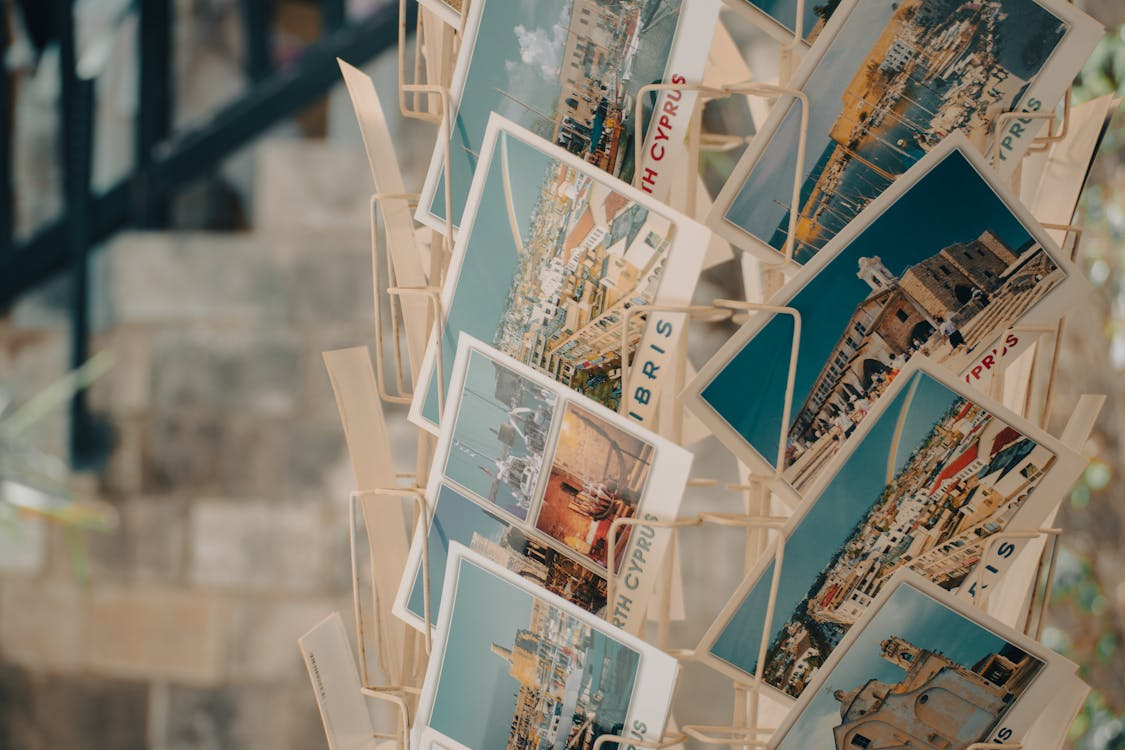
Long before Instagram feeds and travel vlogs, there was a more straightforward way to share your adventures: the postcard.
For over a century, these small, colorful rectangles captured the beauty, humor, and wonder of faraway places, and sent them around the world, one stamp at a time. At the heart of postcard history is a cultural shift, not only documenting travel, but defining it. They shaped how people explored, remembered, and even imagined the world beyond their doorstep.
The Birth of the Postcard
The postcard was officially born in the 1860s, when European postal services began allowing small, single sheets of cardstock to be mailed without envelopes. Austria-Hungary issued the first government-approved postcard in 1869, and other nations quickly followed. Early designs were simple—plain backs for writing, printed addresses, and minimal decoration.
In the 1870s and 1880s, private printers began adding illustrations and photographs, transforming postcards from practical mail into miniature works of art. By the turn of the 20th century, the postcard boom was in full swing. Tourists, soldiers, and everyday citizens alike were sending cards across continents, often collecting them as souvenirs.
During the “Golden Age of Postcards” (roughly 1898–1918), billions were mailed each year. Some historians estimate that in 1908 alone, more than 667 million postcards were sent in the United States—an astonishing number, considering the population at the time.
See The History of the Emoji: From 🙂 to 😊 for how visual messages evolved after postcards.
How Postcards Made Travel Popular
Postcards and travel grew up together. In an era when few people owned cameras, postcards were the most affordable way to bring home an image of where you’d been. Hotels, railroads, and steamship companies quickly realized their marketing potential and began producing postcards to promote tourism.
Images of scenic landscapes, exotic cities, and famous landmarks filled mailboxes around the world, inspiring wanderlust in those who received them. A person might see a friend’s postcard from Paris or Yosemite and start dreaming of going there themselves. In that sense, postcards were the social media of their time. They served as short, visual messages that spread curiosity and connection.
They also made travel more accessible by demystifying distant places. Through postcards, people in small towns could see the Eiffel Tower, the Grand Canyon, or the streets of Tokyo for the first time. The cards served as visual ambassadors for an increasingly interconnected world.
Explore The Surprising History of Everyday Inventions That Started as Mistakes to compare other accidental hits.
Snapshots of Everyday Life
Not all postcards depicted grand landmarks. Many captured ordinary moments, including horse-drawn carriages on main streets, local fairs, bustling markets, or quiet countrysides. These images became a historical record of daily life, preserving how cities and cultures looked at specific points in time.
For collectors and historians today, vintage postcards are invaluable. They offer glimpses of buildings long demolished, fashions long gone, and handwritten messages that reveal the tone and humor of past generations. In a way, postcards are time capsules: personal yet public, fleeting yet enduring.
Even the messages themselves tell stories. A quick “Wish you were here!” scrawled on the back hints at the universal longing for connection, while longer notes often describe adventures, meals, or mishaps in charming, first-hand detail.
Artistic and Technological Evolution
As printing technology advanced, so did the artistry of postcards. The early 1900s saw the rise of color lithography, enabling vivid, detailed images. Later, real photo postcards (RPPCs) used actual black-and-white photographs developed onto postcard paper, blurring the line between souvenir and snapshot.
In the mid-20th century, linen postcards became popular, with textured paper that made colors pop under sunlight. By the 1960s and 1970s, glossy color photography took over, giving rise to the classic travel postcard look familiar to modern travelers.
Design trends also mirrored cultural changes. Vintage cards from the 1940s often featured patriotic or humorous themes during wartime. In the later decades, leisure travel was celebrated, with tropical beaches, roadside motels, and neon cityscapes capturing the optimism of the jet age.
Explore The Real Physics Behind Time Travel (and Why It’s So Hard) to see how tech shapes our sense of distance and memory.
The Personal Touch of Paper and Ink
Despite their simplicity, postcards offered something today’s digital messages can’t replicate: a tangible connection. They carried the sender’s handwriting, the weight of the card, and the imprint of travel itself. The creases, smudges, and postmarks were physical proof that the card had journeyed across the world. They also served as a statement that someone, somewhere, was thinking of you.
Receiving a postcard felt different from receiving a letter. It was public enough to be shared yet personal enough to feel intimate—a perfect balance of form and feeling. Even now, people cherish old postcards not just for their imagery but for their emotional authenticity.
From Souvenir to Sentiment
Though postcards have declined in the age of smartphones and social media, they’ve never truly disappeared. Travelers still send them for the nostalgia, the artistry, and the joy of slowing down. In some ways, their rarity today makes them even more meaningful.
Meanwhile, a new generation of artists and photographers is reviving the medium through limited-edition prints, museum exhibits, and “slow mail” movements that celebrate analog communication. Postcards may no longer be the primary way we share our travels, but they remain a beloved keepsake—a bridge between adventure and memory.
Also read The Forgotten History of Ice Delivery to see how logistics reshaped travel eras and souvenirs.
A Legacy That Endures
The postcard’s legacy is about more than paper and ink. It represents how people first learned to share their experiences visually and globally. A tradition that continues in every travel photo and digital post today. Long before hashtags and filters, a postcard could do it all: capture a moment, tell a story, and make someone far away feel part of your journey.
So next time you travel, consider sending one. It may seem old-fashioned, but slipping a handwritten card into a mailbox is still one of the simplest, most human ways to say, “I was here and I thought of you.”