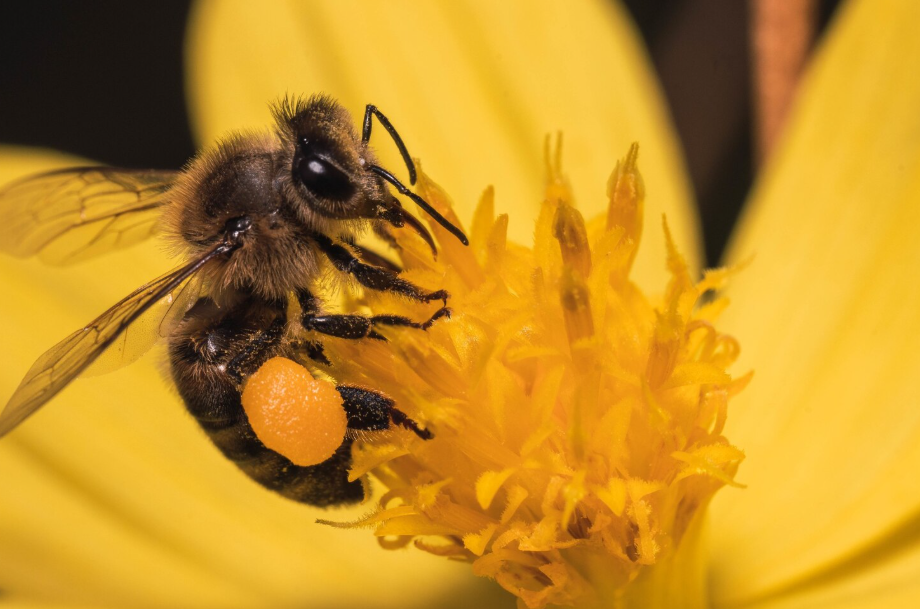
Bees are nature’s expert foragers, capable of navigating vast landscapes to locate the best flowers for nectar and pollen. Their choices aren’t random—they’re guided by a complex mix of visual cues, scent signals, memory, and even electrical energy fields. how bees choose flowers
Each decision a bee makes contributes to both its colony’s survival and the reproduction of plants around the world. Understanding how bees choose flowers reveals just how sophisticated these tiny pollinators really are.
The Language of Color and Pattern
Bees see the world very differently from humans. While we perceive the visible spectrum from red to violet, bees are blind to red but can see ultraviolet (UV) light, allowing them to access visual cues hidden from our eyes. Many flowers have evolved ultraviolet patterns called nectar guides, which are invisible to us but serve as glowing roadmaps for bees. These UV patterns lead bees straight to the nectar, ensuring the flower’s pollen is also collected and spread.
Bright blues, purples, and yellows tend to attract bees most strongly because they stand out vividly in their UV-visible range. Some flowers even change color as they age or after being pollinated, signaling to bees that they no longer offer nectar, helping the insects conserve energy and time. This vibrant communication between flower and pollinator is a fine-tuned partnership shaped by millions of years of evolution.
See Can Animals Sense Natural Disasters Before Humans Can? for how wildlife reads subtle environmental cues.
The Power of Scent
Visual cues are only half the story. Bees also rely heavily on scent, sometimes even more than sight. A flower’s fragrance is made up of a cocktail of volatile organic compounds that act as a calling card for pollinators. Each species has a unique scent fingerprint that tells bees not just that nectar is present, but also whether it’s worth the visit.
Bees can memorize and distinguish these complex scent blends with remarkable accuracy. They even learn which scents correspond to the most rewarding nectar sources. Once they find a flower that provides rich nectar, they’ll return to it, and others like it, again and again, guided by their exceptional sense of smell. Flowers, in turn, compete to produce the most alluring fragrances, ensuring their survival through successful pollination.
Explore The Science of Smell: Can We Digitize Scent? to compare chemical cues in tech and nature.
The Waggle Dance: Bee Communication in Motion
When a bee discovers a particularly productive patch of flowers, it doesn’t keep the secret to itself. Instead, it performs one of nature’s most fascinating behaviors, referred to as the waggle dance. This rhythmic movement, performed inside the hive, encodes precise information about the location of food sources, including direction, distance, and quality.
By analyzing the angle of the waggle in relation to the sun, other bees can chart a course directly to the flower patch. It’s an extraordinary example of animal communication: a symbolic dance language that allows entire colonies to coordinate complex foraging operations without verbal communication. The waggle dance helps ensure that bees don’t waste time searching mindlessly; instead, they focus their efforts where resources are plentiful.
Explore How Do Jellyfish Glow Without Electricity? to compare nature’s signaling tricks.
Reading Electrical Fields
In recent years, scientists have uncovered yet another layer to bees’ sensory toolkit—the ability to detect electrical fields. As bees fly, their bodies build up a small positive charge, while flowers carry a negative one. When a bee approaches, this charge difference allows it to detect whether another bee has recently visited a flower. Flowers that have already been drained of nectar temporarily lose some of their negative charge, signaling that they’re not yet replenished.
This electrostatic sense gives bees a real-time advantage, helping them prioritize the freshest, most rewarding blooms and avoid unnecessary effort. It’s a silent communication network between insects and plants, invisible yet vital to the flow of life in an ecosystem.
Memory, Learning, and Precision
Bees are capable of impressive cognitive feats for their size. They can remember dozens of flower types and locations, navigate back to their hive using landmarks and the sun’s position, and even make time-based decisions about when certain flowers are likely to open. Through trial and error, they learn which colors, scents, and patterns lead to the best results.
Researchers have even shown that bees can count small numbers and distinguish human faces, underscoring the sophistication of their tiny brains. Their behavior isn’t mere instinct. It’s learning and memory in action, fine-tuned for survival and efficiency.
Also read Could Trees Really Communicate Through Underground Networks? for another hidden signaling system.
The Mutual Benefit of Pollination
Every trip a bee makes is a transaction between the insect and the plant. The bee gains energy-rich nectar to feed itself and its colony, while the plant receives the essential service of pollination. Without bees and their finely tuned decision-making, much of the world’s food supply and natural biodiversity would collapse. Approximately one-third of the food humans eat depends directly or indirectly on bee pollination.
The next time you see a bee hovering over a patch of wildflowers, know that it’s not just buzzing randomly. It’s analyzing light, scent, memory, and even electricity to make the smartest possible choice. Nature’s smallest pollinators are also among its most strategic.