
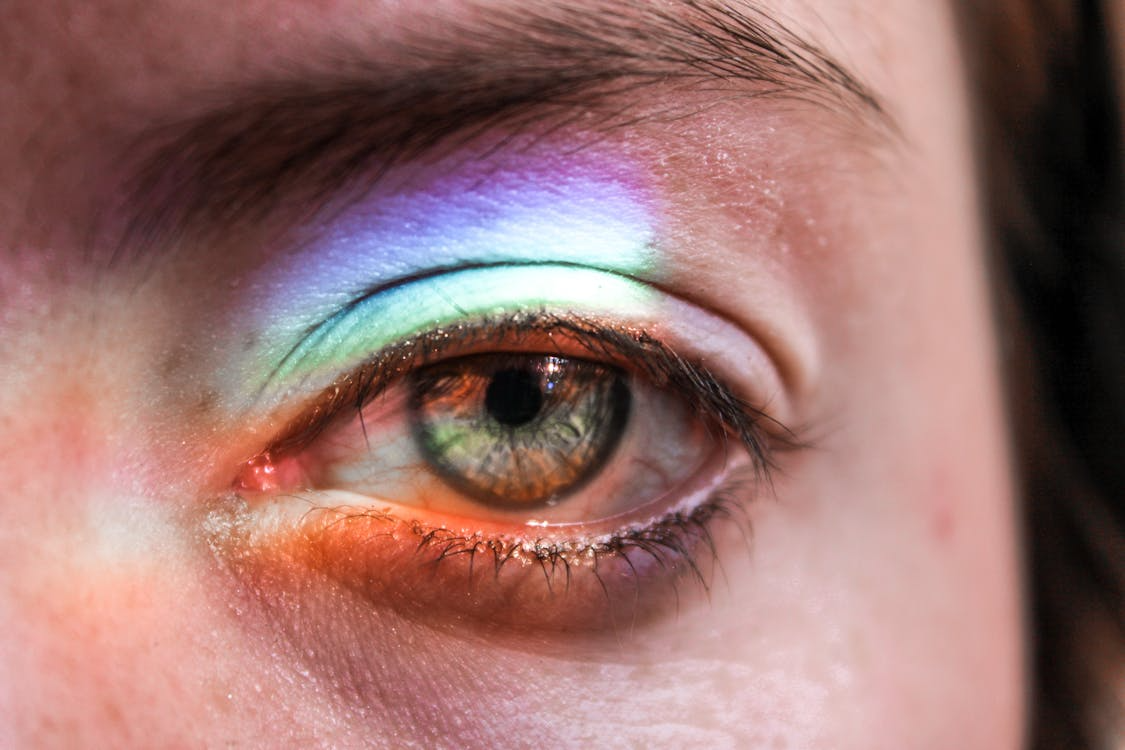
Most people see the world through a similar range of colors—roughly a million shades spanning the familiar rainbow. But for a small number of individuals, the world is far more vivid. They can distinguish hues most of us can’t even imagine.
These people are known as tetrachromats, and their eyes contain an extra type of color receptor that allows them to perceive up to 100 million shades of color. So what makes some people see more colors than others—and what does that reveal about the hidden complexity of human vision?
How Human Color Vision Works
Human color perception depends on specialized light-sensitive cells in the retina called cones. Most people have three types of cones:
- S-cones for short wavelengths (blues)
- M-cones for medium wavelengths (greens)
- L-cones for long wavelengths (reds)
Each cone type responds to different parts of the light spectrum. The brain then compares signals from all three to construct the rich tapestry of color we experience. This three-cone system is called trichromatic vision, and it’s the basis for everything from painting and photography to digital screens.
However, not everyone sees it the same. Some people have fewer functioning cones, leading to color blindness, while others have more, leading to tetrachromacy.
Check out What’s the Deal With Déjà Vu? for a quick dive into memory glitches.
The Science of Tetrachromacy
Tetrachromacy occurs when a person has four distinct types of cone cells rather than three. This allows their eyes to detect wavelengths between the standard red, green, and blue ranges—creating subtle distinctions invisible to the rest of us.
The condition is believed to be linked to the X chromosome, which carries the genes for red and green color receptors. Because women have two X chromosomes, they are more likely to inherit slightly different versions of these receptor genes—potentially giving rise to a fourth, distinct cone type.
Estimates suggest that as many as 10–15% of women might have the genetic potential for tetrachromacy, though only a fraction actively use it. For most, the extra cone doesn’t provide meaningful differences unless the brain also learns to process those extra wavelengths as unique colors.
In contrast, men—who have only one X chromosome—rarely develop tetrachromacy, though they are more prone to color vision deficiencies.
Read How Do Artists “See” Colors Differently Than Everyone Else? to see how perception shapes color awareness.
Seeing the Invisible
For confirmed tetrachromats, the world can look dramatically different. They can detect nuances between colors that appear identical to trichromats. For example, two lipsticks that appear to be “the same red” to most people may be completely different shades to them.
Some report being overwhelmed by certain color combinations or noticing subtleties in fabrics, flowers, and art that others can’t see. Artists with tetrachromacy may even use this extra perception to create more layered, luminous works.
However, there’s no universal “supervision” experience. Because color exists only in the mind—constructed from how our brains interpret light—each person’s internal palette is unique. Tetrachromats don’t necessarily see new colors outside the visible spectrum; they perceive more variation within it.
See Why Do Some People Remember Smells More Vividly Than Faces? to compare smell vs sight in memory.
Testing for Extra Color Vision
Scientists test for tetrachromacy using a combination of genetic analysis and color differentiation tests. Participants are asked to distinguish between very subtle shades that appear identical to trichromats.
In one famous case, neuroscientist Dr. Gabriele Jordan at Newcastle University identified a woman known only as “cDa29” who could consistently detect color differences no one else could. Her vision may represent true human tetrachromacy—the ability to perceive a range of color variation ten times greater than usual.
That said, environment and experience also play a role. Even if someone has four cone types, their brain must learn to interpret the extra input. Without that cognitive adaptation, the potential remains dormant.
Color Vision Beyond Humans
Humans aren’t the only tetrachromats in nature. Many birds, fish, reptiles, and insects have four—or even more—cone types, often extending into ultraviolet wavelengths. For them, seeing a broader color spectrum is essential for survival, helping them spot mates, predators, or ripe fruit invisible to human eyes.
Compared to these species, human color vision is modest—but evolving technology may change that. Scientists are experimenting with optogenetic therapy and retinal implants that could one day expand human color perception, allowing us to see beyond the traditional rainbow into ultraviolet or infrared ranges.
Explore Why Do We Love Watching Things Fall (Like Dominoes or Sand Art)? to understand visual pleasure.
The Beauty of Subjective Color
Ultimately, color is not an inherent property of the world. It’s a neural interpretation. What we call “red” or “blue” is how our brains translate wavelengths of light into sensation. Tetrachromats remind us that reality is filtered through biology: what one person sees may not be what another perceives at all.
Whether you see one million colors or one hundred million, every shade reflects the same astonishing principle—that our eyes and brains transform light into experience. And in that sense, color vision isn’t just about what’s visible; it’s about how each of us uniquely paints the world in our minds.