
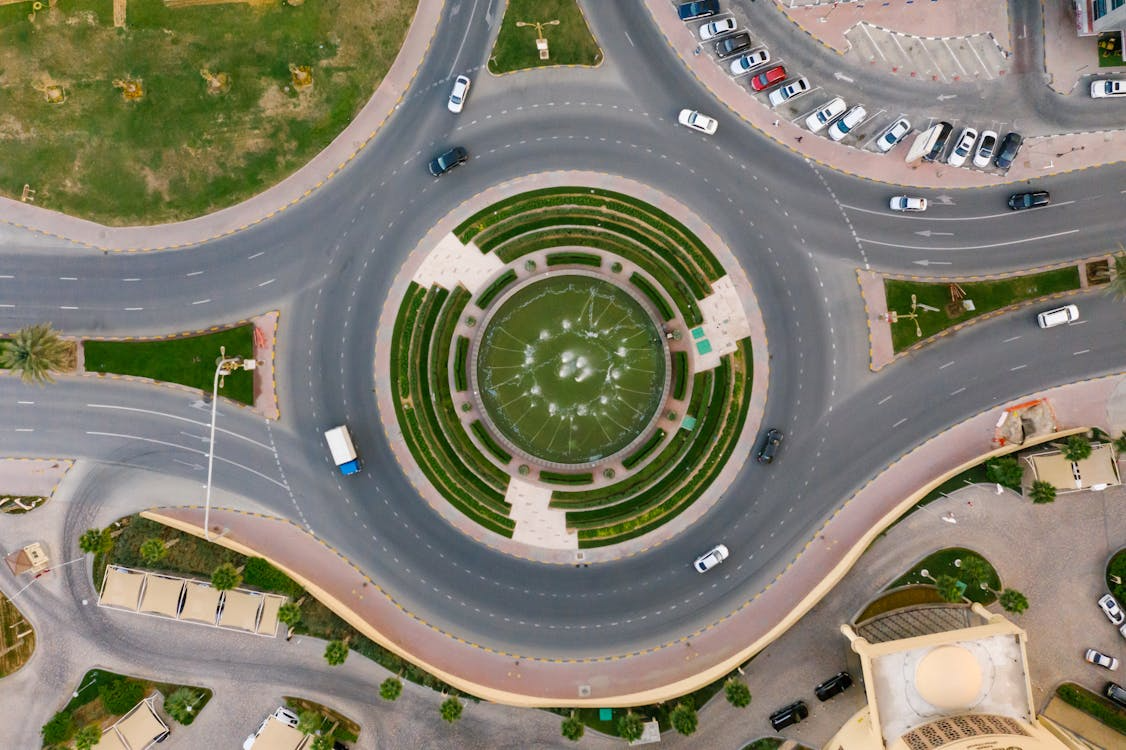
Why do some countries favor roundabouts vs intersections? If you’ve ever driven in the U.K., France, or Australia, you’ve probably encountered countless roundabouts—sometimes one after another. Yet in other countries, like the U.S. or Canada, they’re far less common.
This global divide raises an interesting question: why do some nations embrace roundabouts while others stick with traditional intersections? The answer lies in a mix of history, traffic engineering, psychology, and public perception.
A Brief History of the Roundabout
The concept of the roundabout dates back to the early 1900s, but it wasn’t always the smooth-flowing system we know today. Early versions were chaotic traffic circles that often led to jams rather than solving them. Cars would enter without yielding, resulting in confusion and accidents.
The modern roundabout as we know it today originated in the United Kingdom in the 1960s, when engineers introduced the yield-on-entry rule. This simple change, requiring incoming drivers to give way to vehicles already in the circle, transformed the roundabout into a highly efficient intersection. Traffic flowed continuously, delays dropped, and collisions became less severe.
From there, the design spread rapidly across Europe and other Commonwealth countries, becoming a hallmark of modern urban planning.
Check out How Postcards Changed the Way We Traveled for a peek at how design shaped early travel culture.
Why Some Countries Embrace Them
Roundabouts appeal to countries that prioritize safety, efficiency, and cost-effectiveness in road design. They reduce the number of conflict points (places where vehicles can collide) from 32 in a traditional four-way intersection to just 8. As a result, they significantly reduced severe crashes, especially deadly right-angle and head-on collisions.
In France, where roundabouts are practically a national icon, there are now more than 30,000 of them. French engineers found they improved traffic flow in small towns and rural areas where signals weren’t practical. The U.K., meanwhile, boasts around 25,000 roundabouts, thanks to decades of government policy encouraging safer road layouts.
Australia and New Zealand followed suit, incorporating roundabouts into suburban development to calm traffic and reduce congestion without costly stoplight systems. Their drivers, raised on the yield-first culture, navigate them with ease.
The American Resistance
So why hasn’t the U.S. adopted roundabouts to the same extent? The short answer: habit, history, and perception.
When American cities were first designed for cars in the early 20th century, the grid system dominated urban planning. Stop signs and traffic lights became the norm. Roundabouts, then known as “traffic circles,” were seen as confusing and accident-prone. Some early American traffic circles, such as those in New York and New Jersey, were built too large and lacked proper yield rules, reinforcing their bad reputation.
By the time modern roundabouts gained popularity overseas, Americans had already developed strong cultural attachments to stoplights. Changing that infrastructure was expensive, and public resistance was high. Many U.S. drivers viewed roundabouts as “foreign” or intimidating, particularly older drivers unfamiliar with the yield system.
However, this perception is shifting. The first actual modern roundabout in the U.S. was built in Nevada in 1990, and since then, thousands have been added. Studies by the Federal Highway Administration show that they reduce fatal crashes by up to 90% and serious injuries by about 75%. The statistics prove they’re not just efficient but lifesaving.
Curious how design calms nerves in transit? Read Why Are Airplane Seats Blue?
Culture, Psychology, and Driving Behavior
Another reason roundabouts succeed in some countries more than others lies in the driving culture. Nations that emphasize driver education and lane discipline, such as the U.K. and Germany, tend to integrate roundabouts more successfully. Drivers are trained early to anticipate flow, yield properly, and make quick decisions.
In countries with more aggressive or unpredictable driving habits, however, roundabouts can create stress. The need for cooperation and courtesy—such as yielding, signaling, and maintaining speed—doesn’t mesh well with every driving culture. Infrastructure works best when it matches human behavior, and that balance varies from place to place.
Perceptions of pedestrian and cyclist safety also play a role. While well-designed roundabouts are safer for all users, poorly planned ones can make crossing confusing or intimidating. That’s why countries that prioritize mixed-use roadways invest heavily in multi-lane markings, pedestrian islands, and signage to ensure clarity.
The Global Trend Toward Circular Thinking
Despite cultural differences, roundabouts are spreading worldwide. Engineers appreciate their environmental and economic benefits: they cut idling time, reduce fuel consumption, and require no electricity for signals. In smaller towns, they also serve as community landmarks, often featuring gardens, sculptures, or fountains at their centers.
In recent years, the United States and Canada have begun adopting roundabouts more aggressively, especially in suburban and rural areas. The data speaks for itself. Drivers may resist at first, but once roundabouts are installed, satisfaction and safety ratings rise dramatically.
Navigation relies on more than road signs. See What Would Happen If We Lost All Satellites Overnight?
The Circle Comes Full Turn
Roundabouts are more than just traffic management tools—they’re reflections of how societies think about movement, cooperation, and efficiency. In places where drivers value flow and patience, they thrive. Where control and signals dominate, they struggle to fit in.
But as cities continue to prioritize sustainability, safety, and more innovative design, the humble roundabout is making a global comeback. Whether you love them or dread them, roundabouts represent a rare kind of progress: where a simple circle can make the world’s roads just a little bit safer.