
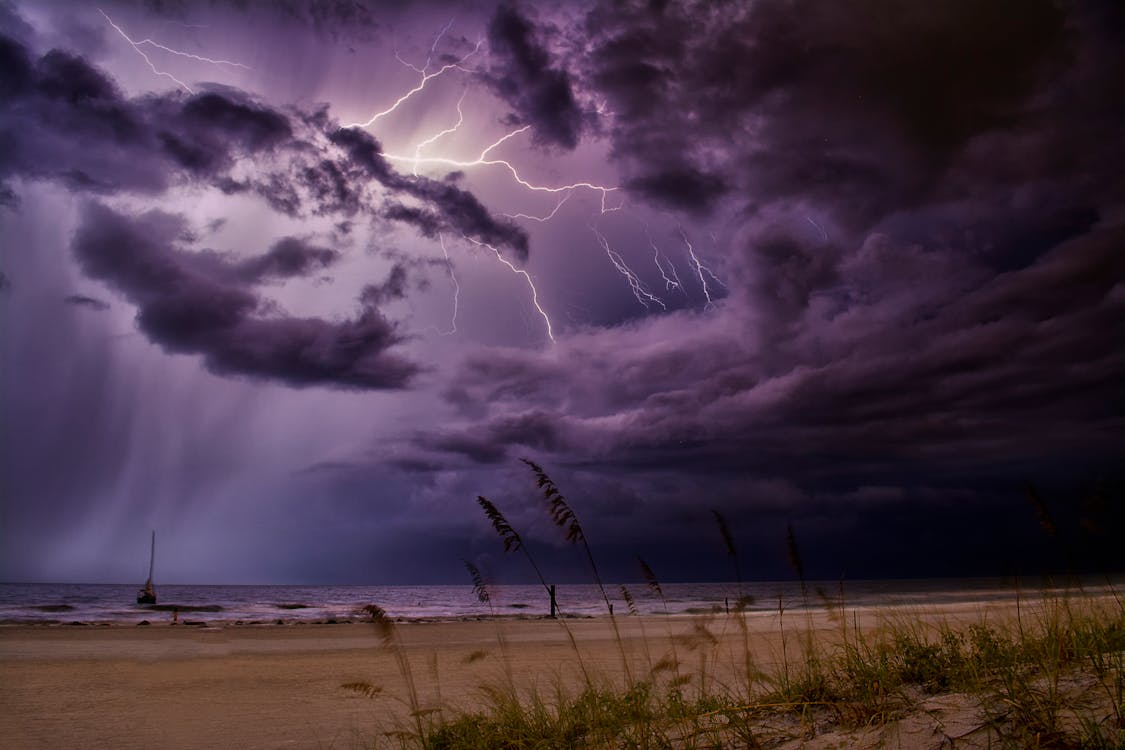
Imagine standing on a beach during a thunderstorm (hopefully from a safe distance). Lightning cracks across the sky and slams into the sand with unimaginable heat and force. When the storm clears, you might find something remarkable left behind—glass.
What you might find, specifically, is a rare natural fulgurite formation in action, sometimes nicknamed “fossilized lightning.” These delicate glassy tubes are nature’s sculptures, created in an instant by one of Earth’s most potent forces.
From Bolt to Glass: How Fulgurites Form
When lightning hits sandy ground, the temperature at the strike point can soar to over 30,000 Kelvin, which is hotter than the surface of the sun. Sand, primarily silica (SiO₂), melts instantly at that heat. As the molten silica rapidly cools and solidifies, it forms hollow glass tubes or branching structures known as fulgurites (from the Latin fulgur, meaning lightning).
The shape of a fulgurite follows the path of the lightning bolt underground. Because lightning seeks the path of least resistance, each strike carves out a twisting, root-like form that mirrors the discharge pattern of electricity. These tubes can be a few inches long or stretch several feet below the surface, tapering as the current dissipates.
While lightning often strikes beaches, fulgurites also form in deserts, dunes, and even mountaintop soils containing enough silica or quartz. The result is always the same—Nature’s glass, born in a flash.
Read Can Animals Sense Natural Disasters Before Humans Can? for more on how nature “reads” storms.
The Science Hidden Inside
Fulgurites aren’t just fascinating to look at. They’re valuable to scientists. Each one captures a geological and atmospheric moment frozen in time. The minerals inside may record chemical signatures of the strike, including melted grains, vaporized elements, and even traces of gases trapped in glass.
Geologists use these clues to study lightning origins and frequency, soil composition, and even ancient climate patterns. For example, researchers have found fulgurites dating back tens of thousands of years, helping to map historical lightning activity and understand how storms have shaped Earth’s surface over time.
Some fulgurites contain lechatelierite, a pure, nearly colorless form of silica glass that forms only under extreme heat and pressure. These conditions are impossible to replicate outside of a lab or nuclear blast. In a way, each fulgurite is both a scientific record and a natural wonder. It’s a perfect intersection of geology and physics.
Curious why some night seas glow? Read How Do Jellyfish Glow Without Electricity?
Nature’s Hidden Artwork
Despite their dramatic origins, fulgurites are surprisingly fragile. Their outer surfaces often look like ordinary sand or stone, rough and dull to the eye. Inside, however, they reveal smooth, glassy interiors that shimmer with subtle colors, from pale beige to smoky gray or greenish hues, depending on the minerals in the sand.
Collectors treasure them for their rarity and beauty, but their true artistry lies in their ability to capture chaos. Every twist, hollow, and curve traces the precise moment lightning met earth, turning destructive energy into something enduring. No two are ever alike. Each fulgurite is a natural fingerprint of a single bolt’s journey.
The Power and Danger of the Strike
It’s tempting to think of lightning as a purely atmospheric phenomenon, but each strike can affect the ground long after the flash is gone. In addition to forming fulgurites, lightning can alter soil chemistry, kill tree roots, or even fuse rock layers. A single bolt can deliver up to a billion volts of electricity, spreading across a wide area in microseconds.
For this reason, fulgurites are always formed by chance; never by design. Attempting to create one intentionally is dangerous and often unsuccessful. Scientists who study them rely on natural occurrences, or in rare cases, lightning research facilities that capture controlled strikes on sandy surfaces under safe conditions.
Love weather’s strange side? See How Will Climate Change Affect the Colors of the Ocean?
A Bridge Between Earth and Sky
Fulgurites serve as a reminder that even destructive natural forces can produce beauty and insight. In one brief instant, lightning—a phenomenon of the heavens—interacts with the Earth to leave behind something tangible, delicate, and lasting. Each fulgurite is a bridge between sky and soil, chaos and creation.
In ancient cultures, these formations were sometimes seen as sacred or magical, thought to contain the power of storms. Today, we see them as natural records of energy and transformation. It’s proof that nature’s violence and artistry often go hand in hand.
The next time thunder rumbles over a stretch of sand, remember: beneath that flash of light, the Earth may be crafting a glassy relic, hidden just below the surface, waiting to tell the story of a single spark that touched the ground.